Showing posts with label Visit Orvinio. Show all posts

Tuesday, May 2, 2023

Spring at Vallebona Country House

Every season has its positive aspects. Spring at Vallebona is an extraordinary period because it is possible to see the first flowers appear: daisies, chamomile, violets, but also the special orchids for which the Parco dei Monti Lucretili was created.

In this period, the mild temperatures allow you to have lunch outdoors and stay under the sun, without umbrellas. In the sky you can often see buzzards flying with their young because they have their nest on Monte Castellano, the mountain above Vallebona.


Between May and June, when it is not yet too hot for them, the pleasant song of nightingales can be heard. If you put music in the house it is easy to see some nightingale arriving on the windowsill that responds to the musical call, it is a real show. They like particularly Rhyanna!

The mild temperatures are also perfect for trekking. You don't need to take the car if you want to go on one of the nearby paths, such as the one that goes to Monte Castellano, the one that goes to Morretta or Pratarelle.

The photos show the intense green typical of this period, in which the heat and the moist soil allow the growth of flourishing meadows, as in the English countryside.


Monday, March 20, 2023

The Church of Santa Maria del Piano

You can reach the Church of Santa Maria del Piano going to the main street (Via Licinese) by car and then walk along the white road or, if you like, you can walk all along the way.

The origin of the Church of Santa Maria del Piano should date back to the 9th century AD. and should have been founded following a victory of the army of the Emperor Charlemagne over the Saracens in the adjacent plain, to thank the Virgin Mary for her help.

A rich Benedictine Abbey linked to the powerful Abbey of Farfa had developed around the church, but starting from the 16th century a long phase of decline and abandonment began in which the site was frequented only for some celebrations and rural customs.

Until the 1970s the church was located in the territory of Pozzaglia, but it was under the control of Orvinio, then it became state property.

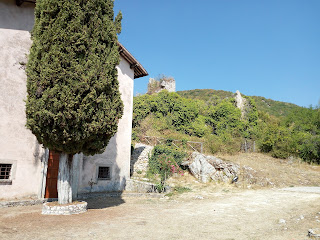
The church had a Latin cross plan with a semicircular apse. The bell tower is still standing and is characterized by multiple levels of triple lancet windows. It is still possible to observe traces of the old convent, but in general the situation of the building is critical and important finds such as the rose window of the central tympanum have been stolen.


For more information: http://www.bollettinodarte.beniculturali.it/opencms/multimedia/BollettinoArteIt/documents/1344607784988_02_-_Lorenzo_Fiocca_p._405.pdf

Rio Petescia waterfalls

If you continue past the Church of Santa Maria del Piano, walking along the paths that cross the pastures, you will come across the Rio Petescia. We follow its course to get to the waterfalls. Sometimes you need to change banks, but the fords are easy, even the path is often blocked by vegetation, but with a little patience and a good stick, you can pass. However, the difficult route is worth it because you finally reach a wonderful and wild waterfall about 4/5 meters high. You can swim in the pool below around July-August, even if the water is very cold. 

You can go back on dirt roads and paths that rejoin the outward path, just before the abbey. 

Click on su WIKILOCK to find the exact path.

Orvinio: one of the most beautiful villages in Italy

History of the village

Orvinio was born in the period of occupation by the Sicels of Sabina and around the first decades of the year 1000 it fell under Benedictine rule, given its proximity to the powerful Benedictine Abbey of Santa Maria del Piano (see further on).

Subsequently Orvinio was owned by the Orsinis and, with the reform of 1816, the barony was established, until Prince Camillo Borghese renounced his feudal rights over Orvinio.

In the 1800s, Orvinio became part of the Papal States and was the seat of government and residence of the Governor.

It remained under the province of Rome until the province of Rieti was created in 1927.

As soon as you arrive at the main crossroads on Via Roma, on the left is the delightful stone staircase which in summer is covered with red geraniums as in the photo.


Santa Maria dei Recommended

Going up these stairs you arrive at the church of Santa Maria dei Recommendations, visible at the top of the photo.

The church was built just outside the walls of Orvinio in 1582 and was part of the former Franciscan convent and hostel for pilgrims, which was held by the Conventual Religious until the Napoleonic era.

In 1653, under Pope Innocent X, the convent was suppressed and reopened only when the municipality gave support to the monks.

The adjacent cloister has a beautiful view over the countryside. The interior has a single nave with side altars. The church is notable for the seventeenth-century frescoes by Vincenzo Manenti, a native of Orvinio.

The facade was redone in a neoclassical style. Currently the church is held by the Confraternity of the Gonfalone and mass and procession are celebrated in the name of Sant'Antonio.

In the summer, concerts are often held in the church of Santa Maria dei Recommendations.


Castle Malvezzi Campeggi

Going beyond the marble arch that gives access to the historic center, you arrive at the church of San Nicola, who is the patron saint of the town.

On the left you go up towards the perimeter walls of the Malvezzi Campeggi castle, unfortunately not open to visitors. Of the original building, which was renovated in the 20th century, only the cylindrical tower and the crenelated walls surrounding the historic center remain. Just around them you can take a beautiful walk from which you can enjoy a wonderful view over the valley, it is easy to see grazing cows, but also wild boars with their litters, especially in summer. When the hay is high, the meadows move under the pressure of the wind, constantly changing color and you can take beautiful photos.

Sanctuary of Santa Maria di Vallebona

The Sanctuary of Santa Maria di Vallebona was built around 1643 thanks to the donations of the inhabitants of Orvinio. It is located where the old village of Vallebona used to be, clearly visible from the watchtower, now almost in ruins, which according to some dates back to the year 1000.

According to legend, the inhabitants of Orvinio decided to build the sanctuary there because a shepherd, in the act of cutting branches in that area, struck an image of the Virgin hidden among the brambles and heard a cry. The image began to bleed.

The shepherd ran into the village to tell the others of her discovery and the villagers decided to keep the image in one of the churches of Orvinio.

The next day, however, the image was gone and was found at the original find site. It was therefore decided not to move it from there anymore and to build the current sanctuary on that spot.

On the main altar there is, in fact, the fresco of the Virgin in the act of handing milk to the Child.


Orvinio's pizza

The town's heritage is the white and red pizza from the only oven in Orvinio which is a favorite destination for cyclists, motorcyclists and Sunday vacationers. The pizza alone is worth the trip to town!

The Taka Pizza and Restaurant, on the main street, offers traditional cookery, pizza and sweets. The owner, Katia Taddei, can provide also special gluten-free food and pizza. 

The Orchid Garden in Pratarelle

If you go from Orvinio towards Scandriglia, along the provincial road, you come across the Orchid Garden in Pratarelle, a little protected land that becomes fully colored with flowers in Spring. 

On the right side of the provincial road there is a beautiful stone fountain in the center of a windy plateau, while on the left there is access to the Orchid Garden, recognizable by the billboard of the Monti Lucretili Park.

From Casa Vallebona it is advisable to reach the Orchid Garden on foot with a 10-15 minute walk.

This below is the view that can be enjoyed from the orchid garden.